The big question for brand owners:
Who pays the price for more sustainability?
Thomas Reiner | 02.05.2019
Should there be more sustainability? Of course, definitely so! But what may this increase in sustainability cost? And who bears these additional costs?
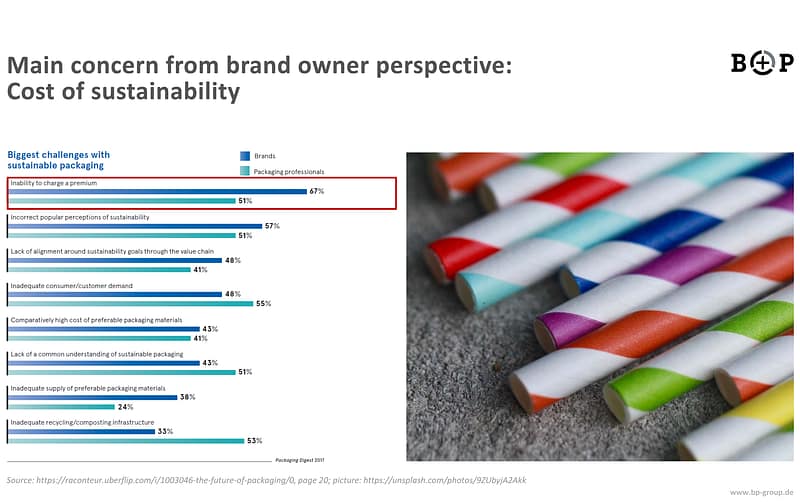
A survey conducted with brand owners in 2017 identified the biggest challenges facing the sustainable optimization of packaging:
With 67% – and by a considerable gap away – the number one position marks the difficulty or impossibility of passing on the additional costs of sustainability to consumers. That sustainability isn’t free of charge is part of the reality that must be accepted. For example, recycling plastics currently cost around 25 percent more than conventional plastics. Of necessity one will have to think about compensating internally for the part of the additional costs that one can’t be passed on.
In second place – at 51% – regarding the biggest challenges facing brand owners for the sustainable optimization of their packaging portfolio, is the consumers’ lack of understanding concerning the offered, sustainable solution. After all, what good is a packaging that is sustainable in reality if the consumer doesn’t recognize and classify it as such? Information and communication are very important in this regard.
The following places then follow:
• The lack of a consistent sustainability orientation in the value chain (48%).
• The insufficient demand from consumers / customers (48%).
• The comparatively high cost of required packaging material (43%).
• The lack of common, unified understanding of what truly constitutes sustainable packaging (43%).
• The insufficient supply of desired, sustainable packaging materials (38%)
• The inadequate infrastructure for recycling or composting (35%).
The additionally surveyed packaging experts rated the challenges rather differently. For instance, only a slight majority of 51% see the passing on of the additional costs of sustainability as the biggest challenge. The dominating factor is rather seen as the inadequate demand from consumers / customers (55%), followed by the insufficient infrastructure for recycling and composting (53%).